Lambeth Development Finance 2026: Vauxhall/Nine Elms Eastern Absorption, Brixton Growth & The South Bank Mixed-Use Play
Lambeth is down 3.5% year on year in February 2026, against a Greater London headline of -3.3%. Twenty basis points softer than the regional benchmark — a softer-than-average inner-south borough number, but only just. The flat headline disguises something genuinely unusual on the inner London map: Lambeth is the borough running two simultaneous structural stories at the same time, and the Land Registry number is the volume-weighted average of both.
Lambeth contains the eastern half of the Nine Elms regeneration spine — Vauxhall and the embassy quarter, sister to Wandsworth’s western half across the borough boundary at Battersea. It also contains a structurally active mid-tier resi-led growth corridor running Brixton, Stockwell and Kennington. It contains Waterloo and the South Bank — fringe-City, cultural-anchored, mostly mixed-use. And it contains the family-resi outer arc of Herne Hill, West Norwood and Streatham. One -3.5% borough number, four valuation models running underneath it.
Why Lambeth has two simultaneous stories in 2026
The headline coverage of inner south London tends to bracket Lambeth with Wandsworth as the joint Nine Elms regen pair. The bracketing is half-right. Vauxhall and the embassy quarter is genuinely the eastern half of the same masterplan that produced Battersea Power Station and Embassy Gardens to the west — same Northern Line extension structural unlock, same completion bunching, same open-market resi absorption layer dragging through 2024 to 2026, same institutional BTR forward-fund take-outs running underneath. If Lambeth held only the Vauxhall sub-zone, the borough would price like Wandsworth at -3.0% with a slight south-of-the-river premium tipping it slightly softer.
It does not. The second story running in parallel is the Brixton, Stockwell and Kennington mid-tier resi-led growth corridor — and that is the borough’s structural pipeline going forward. Brixton and Stockwell are in the third year of a creative-cluster-anchored mid-rise resi-led densification that has not bunched into completion the way Nine Elms did. Kennington is converting underused commercial stock and tired secondary office floor into resi at scale. The Land Registry number captures the absorption drag at Vauxhall and the structural growth in Brixton on the same volume-weighted line, and the result is the -3.5% Lambeth headline — closer to flat than Wandsworth’s -3.0% would imply if you mapped the two regen halves at face value, because Brixton’s growth is doing real work to hold the borough average up.
That is the practical picture for site acquisition in 2026. Lambeth is not one borough underwriting question. It is two — and the answer to the first one (Vauxhall absorption) does not transfer to the answer to the second one (Brixton growth) at all.
Reading the -3.5% in context
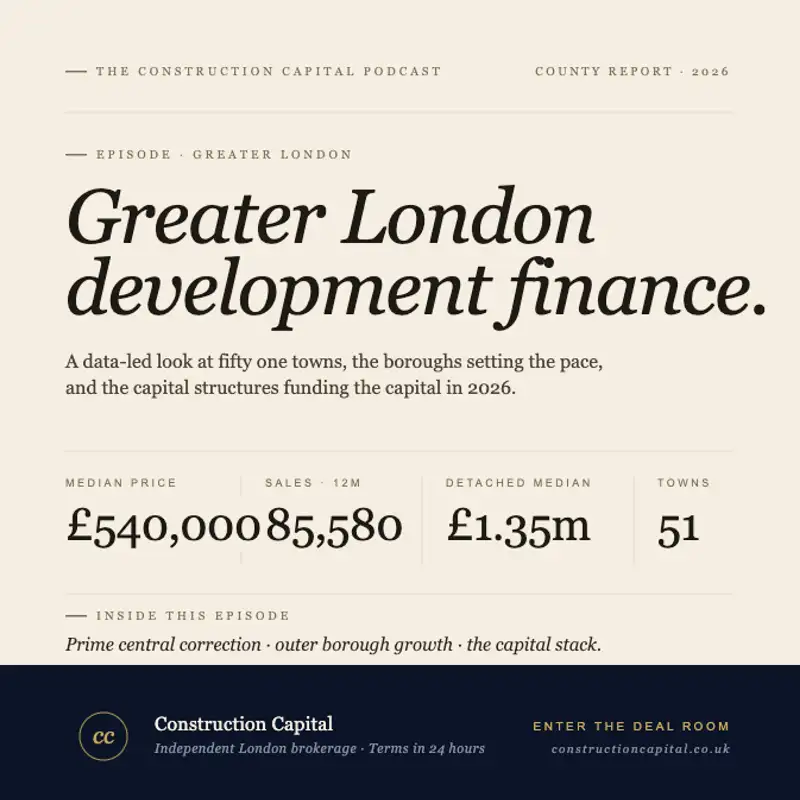
Greater London’s headline house-price index fell 3.3% year on year in February 2026 to a regional median of around £542,000. Lambeth’s -3.5% sits 20 basis points below the regional benchmark. Soft-mid-band, but only just.
For context across the inner-south map. Wandsworth is at -3.0%, the sister regen borough across the Nine Elms boundary, with a deeper Putney premium townhouse belt holding the Wandsworth average up that Lambeth does not have an equivalent of. Hackney at -2.5% is the inner-east mid-tier comparator with a similarly creative-cluster-anchored growth corridor (London Fields, Dalston) holding the borough average up. The Lambeth-Hackney spread is one full percentage point — almost entirely explained by the Vauxhall absorption layer that Hackney has no equivalent of.
Tower Hamlets at -3.8% is the closest inner-east BTR-heavy comparator, with the Canary Wharf and Isle of Dogs high-rise re-sale layer dragging the borough average. Lambeth sits 30 basis points stronger than Tower Hamlets because the Vauxhall re-sale layer is shallower than the Isle of Dogs decade of investor stock, and because the Brixton mid-tier growth corridor is structurally healthier than anything Tower Hamlets has on the same scale. At the other end of the inner London map, Westminster at -10.8% and Kensington and Chelsea at -11.2% across the river are in prime correction. Camden at -6.4% is in mid-correction. Lambeth is none of those camps. It sits soft-mid-band, 20 basis points below London average, with one absorption zone, one growth corridor, one mixed-use story and one quiet outer arc all rolled into the same borough term sheet.
The sub-zone anatomy: Vauxhall/Nine Elms East, Waterloo/South Bank, Kennington, Stockwell, Brixton, Herne Hill, West Norwood, Streatham
Vauxhall and Nine Elms East (SW8). The eastern half of the Nine Elms regen spine — the embassy quarter, the US Embassy site, the riverside towers running east toward Vauxhall Bridge, large completed BTR and PBSA pipeline. Northern Line extension shares the structural unlock with the Battersea / Nine Elms western half. Tower-led, riverside premium where the consent supports it. This is where the absorption is dragging the borough headline. Institutional BTR forward-funds clear at 5.0-5.5% net yield, in line with Battersea / Nine Elms West.
Waterloo and South Bank (SE1). Fringe-City and cultural quarter — National Rail terminus at Waterloo, Jubilee and Bakerloo, the National Theatre / Royal Festival Hall / BFI cultural anchor, the South Bank Centre footprint, IBM and ITV-adjacent commercial stock at the eastern edge. Mostly mixed-use; commercial-to-resi conversion potential at the upper end. High-GDV per scheme, lower-volume pipeline. Fewer schemes per year, but the schemes that transact are large.
Kennington (SE11). Premium domestic plus BTR-conversion zone. Kennington Park, the Oval, Vauxhall fringe at the western boundary. Northern Line at Kennington and Oval. Conversion of underused commercial stock to resi and BTR is the dominant 2026 product — including some former government-occupied office and embassy-quarter spillover. Premium hold-up zone for the established Georgian terrace stock around Kennington Lane and the Park.
Stockwell (SW9). Mid-tier resi-led delivery zone. Northern and Victoria Lines at Stockwell — one of inner London’s better dual-line interchanges. South of Vauxhall, north of Brixton. Brownfield and tired-secondary-retail footprint similar to Tooting on the Wandsworth side, with Lambeth planning receptive to mid-rise densification in the station catchment.
Brixton (SW2 / SW9). The borough’s creative-cluster anchor and the structural growth corridor. Victoria Line terminus, National Rail. Brixton Market, the Academy, the night-time economy footprint. Mid-rise resi-led mixed-use is the dominant consent profile. The borough’s most reliably-clearing mid-rise resi appraisal in 2026, and the sub-zone running closest to flat year on year.
Herne Hill (SE24). Family resi belt south of Brixton, around Brockwell Park. National Rail to London Bridge and Blackfriars. Edwardian and Victorian terrace stock, low absorption noise, low re-sale exposure. Bridging-led value-add reposition is the dominant capital flow.
West Norwood (SE27). Quieter family-resi sub-zone south of Herne Hill. National Rail catchment. Lower-volume pipeline, similar profile to Herne Hill but at a softer price point.
Streatham (SW16). The borough’s outer-fringe family-resi corridor. National Rail at Streatham, Streatham Hill and Streatham Common. The Crossrail 2 alignment story, still planning-stage and under-debate, sits in every Streatham underwriting model as a long-term value accelerator the way Tooting does on the Wandsworth side. Mid-rise resi-led mixed-use is the financeable consent profile.
Why Vauxhall / Nine Elms East is dragging the borough average through absorption
This is the part that matters most for site acquisition in 2026, and it is the part the borough headline is actively obscuring.
The Vauxhall and Nine Elms East quarter completed several thousand open-market resi units across 2023 to 2025, alongside completed BTR estates and PBSA. The dynamic on the open-market resi layer is identical to the Wandsworth half of Nine Elms: original-sale comparables priced when senior debt cost 4.5% and the long-end mortgage market priced 1.5%, landing into a 2026 environment where the long-end mortgage market is closer to 4.5% and the institutional capital cost has reset. Simultaneous completion bunching across the wider quarter compounds the effect. New-build resi comparables in the eastern half of Nine Elms cleared through 2025 at 5 to 12 per cent below 2021-2022 original-sale tone — the same band as the western half. A measurable share of investor re-sale stock followed.
The institutional BTR pipeline is largely insulated from this for the same reason it is insulated on the Wandsworth side: BTR is a yield-on-rent product, not a capital-comp product. A 5.0-5.5% net yield on a credible Vauxhall forward-fund clears its appraisal regardless of what individual investor flat re-sale comparables are doing in the same building. But the Land Registry headline does not separate the two. It captures every transaction, weighted by volume, and the open-market re-sale layer is heavier than the BTR completions on the headline number.
For a developer pricing a Vauxhall site in 2026, the practical implication is the same as Battersea / Nine Elms West: the open-market resi appraisal is currently soft and will continue to be soft until the absorption layer clears. The institutional BTR appraisal is robust at 5.0-5.5% net, and the forward-fund pipeline is genuinely active. If you are pricing a site in this sub-zone you are pricing two appraisals, not one — and the appraisal you choose drives the residual land value by 15 to 25 per cent.
What lenders are pricing on Lambeth schemes in 2026
Following the Bank of England’s December 2025 cut to 3.75%, the all-in capital stack on a typical Lambeth scheme is split into three pricing bands inside the same borough term sheet date — and Lambeth is the borough where lenders are running the widest sub-zone band split on the inner London map.
Senior development finance on a Brixton, Stockwell, Kennington or Streatham mid-rise resi-led scheme is available from 6.5% per annum at 65-70% LTGDV for an experienced developer with strong cost certainty in the 60 to 250 home range. Senior debt on a Vauxhall or Nine Elms East high-rise scheme is available from 6.75% per annum at 60-65% LTGDV — tighter leverage, wider margin, both reflect the absorption-zone exposure on the open-market resi back end. Senior debt on a Waterloo or South Bank mixed-use or commercial-to-resi conversion scheme is available from 6.75% per annum at 60-65% LTGDV — pricing reflects the higher single-asset GDV and the mixed-use complexity rather than absorption risk. Stretched senior products start around 7.5% and reach 75% LTGDV where the cost plan and contractor are bankable. Mezzanine finance pricing starts at 12% per annum and stretches gearing to 85-90% of cost.
Bridging loans on Herne Hill, West Norwood and Streatham value-add reposition starts from 0.55% per month at up to 75% LTV, with the upper end of the bridging market — 0.65 to 0.70% per month — applied to the larger Kennington and Brixton-edge premium repositions. Bridging is also active on the Stockwell / Kennington commercial-to-resi conversion pipeline at the same pricing band.
The BTR forward-funding layer on Vauxhall and Nine Elms East institutional schemes is the structural take-out product. Take-out yields are clearing 5.0-5.5% net — broadly in line with Hackney Wick and the Battersea / Nine Elms West half, and 25 to 50 basis points wider than Tower Hamlets Isle of Dogs at 4.75-5.25% net. PBSA forward funding is more meaningful in Lambeth than in Wandsworth because of the South Bank University catchment, with schemes around Waterloo and Kennington clearing 5.5-6.0% net.
The Brixton / Stockwell mid-tier resi-led growth corridor
While Vauxhall absorbs, Brixton, Stockwell and Kennington is the borough’s structurally active mid-tier delivery zone in 2026. Three things make this corridor financeable on the cleanest mid-rise resi-led terms in the borough.
One, transport. The Victoria Line spine from Vauxhall to Stockwell to Brixton is one of inner London’s best vertical transport axes — Brixton is the southern terminus, twelve minutes from Oxford Circus. National Rail at Brixton is a high-frequency commuter route. Stockwell is a Northern / Victoria dual interchange. Kennington is on the Northern Line directly. Every site in the corridor underwrites with strong PTAL and walk-to-station depth.
Two, stock and creative-cluster demand. Brixton’s creative-cluster footprint — the night-time economy, the cultural anchor, the food hall regeneration — has supported a structural rental tone that mid-tier institutional capital is willing to capitalise. Stockwell and Kennington have brownfield and tired-secondary-retail footprint that fits a 4 to 10 storey mid-rise resi-led mixed-use consent profile. Lambeth planning has been receptive to densification in the station catchments along the corridor.
Three, pricing. The corridor clears mid-rise resi-led at 65-70% senior LTGDV from 6.5% per annum — the cleanest financing terms in the borough. The corridor’s resi appraisal is not exposed to the Vauxhall absorption noise on the back end, and not exposed to the Waterloo / South Bank single-asset mixed-use complexity that touches the upper end. It is a clean mid-rise resi appraisal on a Victoria Line catchment with structural rental tone.
For developers running the borough in 2026, the Brixton / Stockwell / Kennington corridor is the conventional mid-rise resi-led play and is where the borough’s clearest financeable consents are sitting.
The Waterloo / South Bank mixed-use opportunity
Waterloo and the South Bank is the borough’s high-GDV, lower-volume pipeline. The cultural anchor — the National Theatre, the Royal Festival Hall, the BFI, the South Bank Centre footprint — combined with the Waterloo terminus and fringe-City commercial stock makes the sub-zone unlike anywhere else in inner south London on a single-asset GDV basis.
The active 2026 product is mixed-use anchored — typically commercial-to-resi conversion at the upper end of the size band, or full mixed-use new-build with commercial podium and resi above. PBSA is active around the South Bank University catchment. The schemes are large by GDV per asset (£60m to £250m+) and the pipeline is thin by count, but the per-scheme economics are strong. Senior debt prices in the same band as Vauxhall high-rise — 6.75% from 60-65% LTGDV — but on different risk economics. The constraint here is not absorption; it is mixed-use complexity, planning, and the cost-plan certainty around heritage-adjacent or culturally-anchored sites.
Conversion of underused commercial stock to resi is the structural through-line on the Waterloo / South Bank product. A meaningful share of fringe-City office floor in the SE1 / South Bank quadrant has cleared at residual values that support resi conversion in 2026, and the Time-Limited Planning Route is favourable to conversion schemes that move quickly through to delivery.
What is actually transacting in Lambeth
Five categories of scheme are running across the borough in 2026.
BTR forward-fund take-outs at Vauxhall and Nine Elms East. The dominant product by GDV. Single-operator estates inside the wider masterplan, typically 200 to 600 units, tower-led where the consent supports it. Take-out yields 5.0-5.5% net. The structural product the eastern half of Nine Elms is optimised for in this cycle.
Mid-rise resi-led on the Brixton, Stockwell and Kennington corridor. 4 to 10 storeys, 60 to 250 homes, brownfield. Conventional capital stack — senior development finance plus mezzanine. The schemes most likely to clear the Time-Limited Planning Route at 20 per cent affordable housing by habitable room. The borough’s structural growth pipeline.
Commercial-to-resi conversion at Stockwell, Kennington and the South Bank. Tired secondary office and underused commercial stock converting to resi or BTR. Bridging-led acquisition followed by senior on the conversion / fit-out, or senior all the way through where the cost plan supports it.
Mixed-use at Waterloo and the South Bank. Lower-volume, higher-GDV-per-asset. Cultural-anchored, fringe-City, commercial-podium-plus-resi or full conversion. Conventional senior plus mezz on the construction layer; PBSA forward fund on the South Bank University catchment elements.
Value-add reposition of Victorian and Edwardian stock in Herne Hill, West Norwood and Streatham. Bridging-financed, 12 to 24 month windows, refurb-to-rent or refurb-to-sell. Low absorption noise, low re-sale layer exposure. The borough’s quietest but most reliably-clearing exit product.
How the capital stack works on a £30-50m GDV Lambeth scheme
A typical mid-cap Brixton, Stockwell or Kennington mid-rise resi-led scheme at this scale, with strong PTAL within a 10-minute walk of a Victoria Line or Northern Line station and a clean planning consent under the new NPPF regime, can be financed with senior development finance at 65-70% LTGDV (around 6.5-7.0%) and mezzanine layered to 85-90% of cost (12% plus). Blended cost-of-funds in the high sixes to low sevens is achievable on this structure.
A Vauxhall or Nine Elms East BTR-led scheme at £60m to £150m+ GDV runs on a different stack. Senior at 60-65% LTGDV (around 6.75-7.25%), mezzanine layered to 85-90% of cost, and an institutional forward-fund commitment locking the take-out at 5.0-5.5% net yield. The forward-fund commitment compresses senior pricing on the construction layer by 25 to 50 basis points relative to an open-market resi structure of the same scale, because the back-end exit risk is materially de-risked.
A Waterloo or South Bank mixed-use scheme at £60m to £250m+ GDV runs on a senior + mezz structure with the higher single-asset GDV economics offsetting the mixed-use complexity. PBSA forward funding at 5.5-6.0% net is the structural take-out for the South Bank University catchment elements. Single-asset structures, often equity-led at lower LTGDV, are a meaningful share of the South Bank pipeline.
On the larger schemes (£100m to £250m+ GDV), the institutional senior pool re-engages at scale, multiple mezzanine providers compete for allocation, and the BTR / PBSA forward-funding conversation widens to include co-living and operator-led specialised resi.
What this means for site acquisition
If you are pricing land in Lambeth in 2026, three things matter more than they have in any recent cycle.
One, the sub-zone is the appraisal, not the borough — and Lambeth runs the widest sub-zone band split on the inner London map. A Vauxhall or Nine Elms East BTR forward-fund scheme runs on capitalised rent at 5.0-5.5% net yield. The open-market resi appraisal on the same building runs on softening per-square-foot comparables in absorption phase. A Brixton mid-rise on the Victoria Line catchment runs on a cleaner mid-rise resi appraisal with no absorption noise. A Waterloo mixed-use scheme runs on commercial-podium-plus-resi GDV economics with a heritage-adjacent planning premium. A Streatham fringe-resi scheme runs on a value-add or mid-rise consent profile with the Crossrail 2 alignment story carrying the long-term upside. Same borough, five valuation models, materially different residual land values.
Two, the BTR forward-fund take-out at 5.0-5.5% on Vauxhall and Nine Elms East is the tightest institutional product in inner south London and is the structural product the eastern half of the borough is optimised for through this cycle. The Brixton / Stockwell / Kennington mid-rise corridor is the structural growth product going forward. If you have a consent that supports either of those underwriting questions cleanly, that is a financeable product on better terms than an open-market resi structure on the same site.
Three, the post-NPPF planning regime, the Mayor’s emergency package and the Time-Limited Planning Route together favour Lambeth schemes that move quickly through to delivery. Capital is available for Lambeth schemes ready to start, whether that is BTR forward-funded construction debt at Vauxhall, conventional development finance on a Brixton or Stockwell mid-rise, bridging for a Kennington commercial-to-resi conversion or a Herne Hill value-add window, or a development exit refinance for a Vauxhall project completing in late 2026.
For full borough-by-borough sold price data, the Vauxhall / Nine Elms East BTR pipeline references, viability modelling and the underlying capital stack benchmarks behind this analysis, see the Greater London Property Market Report 2026. Borough-specific intelligence sits on the Lambeth location page.
See also: Walthamstow +5.9% on YouTube and The £650/sq ft Cliff on YouTube.
Listen to the full episode
For the dedicated deep dive on this borough, we have published a stand-alone Lambeth episode of the Construction Capital podcast: Lambeth -3.5%: Vauxhall / Nine Elms East Absorption, Brixton Growth and the South Bank Mixed-Use Play. Around ten minutes covering the Vauxhall, Waterloo / South Bank, Kennington, Stockwell, Brixton, Herne Hill, West Norwood and Streatham sub-zone read, the BTR forward-fund yields driving the institutional pipeline, the full April 2026 capital stack, and what is actually transacting in 2026.
This article also draws on Episode 2 of the Construction Capital podcast: Greater London Property Development Finance 2026: Market Analysis, House Prices and Lending Outlook. The full borough-level data, policy detail and capital stack discussion runs 15:30, with chapters covering Walthamstow, Bromley, Hackney, Tower Hamlets and the inner-south boroughs within the wider Greater London outlook.
Listen anywhere
Listen on Apple Podcasts, Spotify, Overcast, Pocket Casts, or Amazon Music.
For indicative terms on a Lambeth scheme within 24 hours, submit through the Construction Capital deal room.
Published by Construction Capital, an independent capital advisory brokerage sourcing terms from over 100 lenders across development finance, bridging, mezzanine, and equity. This article is part of the Greater London 2026 series accompanying the Construction Capital podcast.